How to Find Consolidated Pay Details for Employees ?
 |
03 November 2025
|
03 November 2025
Introduction
Employee compensation management plays a vital role in ensuring trust, transparency, and satisfaction within any organization. HR departments are responsible for delivering accurate and timely salary details while maintaining compliance with financial regulations. However, salary structures often involve multiple elements such as basic pay, allowances, and incentives, which can create confusion for employees and complexity for HR professionals. To address this, many organizations have adopted a consolidated pay structure — a simplified approach that combines all salary components into one unified amount.
In this article, we’ll explore what consolidated pay means, why it’s important, and how both HR teams and employees can easily find consolidated pay using modern payroll systems.
Understanding Consolidated Pay
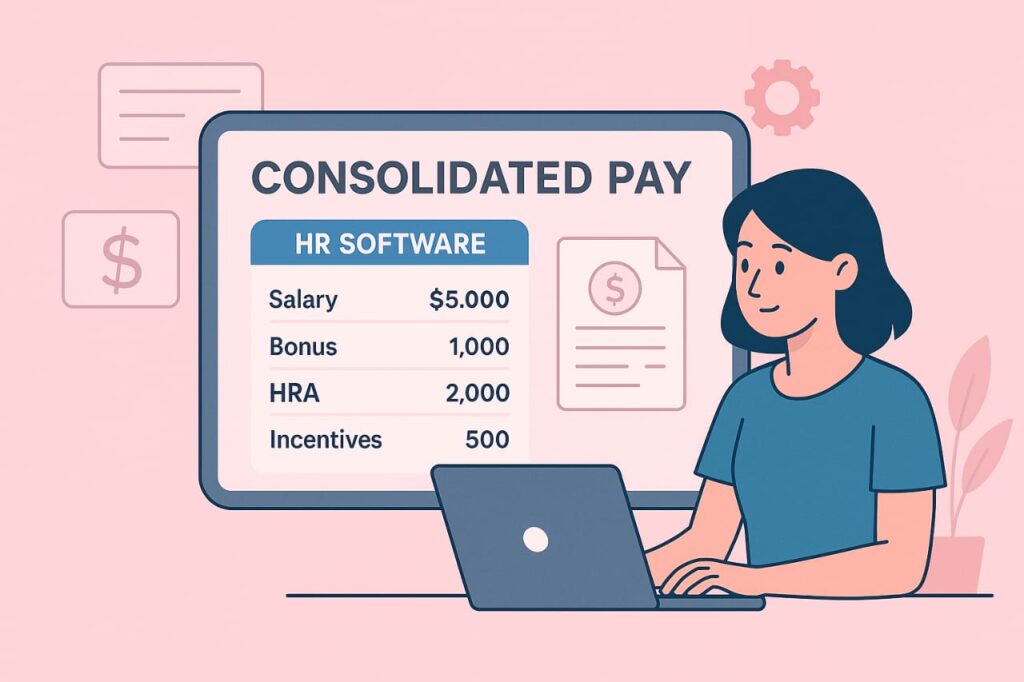
Consolidated pay refers to a single, fixed amount paid to an employee that includes multiple components such as basic salary, allowances, bonuses, and benefits. Instead of breaking down each element, the company provides a total lump-sum figure as the employee’s monthly or annual pay.
For example, an employee earning ₹60,000 per month as consolidated pay may have this amount include their basic pay, house rent allowance (HRA), conveyance, and incentives, all combined into one total. This approach is especially common in contract-based, project-based, or temporary employment where the organization prefers a simpler compensation model.
It eliminates the need for complex salary breakdowns and provides a straightforward structure that benefits both HR teams and employees.
Why Consolidated Pay Matters
It provides distinct advantages for both employers and employees.
For employees, it offers clarity and transparency, allowing them to understand exactly how much they will receive each month. There’s no confusion regarding multiple allowances or variable pay components. It also simplifies financial planning and makes salary comparison easier across organizations.
For employers, consolidated pay reduces administrative complexity and streamlines payroll management. It helps HR teams process salaries faster, maintain clean records, and ensure that payroll compliance is met with fewer errors. Additionally, it simplifies communication during hiring and contract discussions, making it clear what an employee’s total compensation will be.
Difference Between Basic Salary and Consolidated Pay
The main distinction between basic salary and consolidated pay lies in the level of detail and structure. Basic salary represents only a portion of an employee’s total earnings, while consolidated pay combines all income elements into one comprehensive amount.
| Aspect | Basic Salary | Consolidated Pay |
| Definition | Fixed core component of salary | Lump-sum amount covering all pay components |
| Includes Allowances | No | Yes |
| Taxable Amount | Partially | Fully taxable |
| Applicable To | Permanent employees | Contractual or project employees |
| Structure | Detailed | Simplified |
In short, includes basic salary and other elements, making it a single, easy-to-manage compensation model.
Common Challenges in Finding Consolidated Pay Details
While it simplifies salary processing, retrieving or verifying these details can sometimes be challenging. Many organizations still rely on manual payroll management, leading to limited access to salary data. Employees may also find it confusing when pay slips do not show separate salary components. Other issues such as human errors, outdated HR software, or lack of integration between HR and payroll departments can further complicate the process.
To overcome these challenges, modern HR payroll systems are designed to centralize data, automate pay calculations, and allow employees to access their salary details through self-service portals.
How to Find Consolidated Pay Details
The process of finding consolidated pay details varies depending on the HR systems used by the organization, but it generally follows a simple sequence.
The first step is to log into your HR or payroll management system. Most organizations today use platforms like Zlendo HR Payroll, SAP SuccessFactors, or Zoho People. Employees can visit the HRMS portal, sign in using their credentials, and navigate to the Payroll or Salary section. Here, you’ll typically find an entry titled “Consolidated Pay” or “Gross Salary.”
Next, access your payslip or monthly salary statement. This document usually contains your name, employee ID, designation, month, total consolidated pay, deductions (such as tax or provident fund), and your final net pay.
For example:
Employee Name: Priya Sharma
Designation: Analyst
Month: October 2025
Consolidated Pay: ₹58,000
Deductions: ₹2,800 (Tax + PF)
Net Pay: ₹55,200
If you are part of the HR team, you can generate a consolidated pay report for multiple employees or departments. These reports are often available in downloadable Excel or PDF formats and can be filtered by department, month, or employment type.
For organizations that don’t use digital payroll systems, employees can still verify the details by checking their offer letters, contracts, or directly contacting the HR or payroll department.
Benefits of Using Payroll Software for Consolidated Pay
Adopting an automated payroll system offers several benefits in managing it effectively. Payroll software eliminates manual errors, saves time, and enhances data security. With a centralized dashboard, both HR teams and employees can access accurate salary records in real time.
Automated payroll tools also support customizable reporting, making it easier for HR to generate monthly or annual consolidated pay summaries. The inclusion of employee self-service portals allows employees to independently download payslips, view salary history, and verify their consolidated pay without waiting for HR intervention.
Additionally, cloud-based systems ensure that payroll data remains secure and accessible from anywhere, supporting hybrid and remote work environments.
Real-World Example of Consolidated Pay
Consider a technology firm that hires developers on a six-month project basis at a consolidated pay of ₹80,000 per month. This figure covers their basic pay, allowances, and internet reimbursements. Rather than processing multiple components separately, the HR team uses payroll software to automate the entire process.
As a result, salary slips are generated instantly, employees receive accurate payments on time, and the HR department saves several hours each month. The simplified structure not only enhances transparency but also ensures better payroll compliance and record-keeping.
Best Practices for Managing Consolidated Pay
To manage this efficiently, organizations should adopt a structured and technology-driven approach.
It’s essential to use cloud-based payroll management systems that automate calculations and reporting. Maintaining clear and updated documentation, such as appointment letters and pay records, helps avoid confusion. HR teams should also communicate transparently with employees, explaining what is included or excluded from consolidated pay.
Regular payroll audits can help identify errors early, while ensuring compliance with statutory deductions like PF, ESI, and tax laws. Enabling employee self-service options improves accessibility and reduces HR workload.
Essential practices include:
- Implementing automated HR payroll software
- Keeping records and salary structures updated
- Ensuring data confidentiality and compliance
- Conducting routine payroll audits
- Offering employees direct access to their salary data
Future of Consolidated Pay Management
With the growing adoption of artificial intelligence in HR systems, the future of payroll management looks smarter and more predictive. AI-powered payroll tools will soon be capable of analyzing pay trends, forecasting salary budgets, and detecting discrepancies automatically.
Predictive analytics will allow HR professionals to assess salary distribution, generate insights about compensation fairness, and ensure pay transparency. As automation continues to advance, managing consolidated pay will become not only faster but also more strategic, supporting better financial planning and employee satisfaction.
Conclusion
Finding and understanding consolidated pay details no longer needs to be a complex task. With digital payroll systems and automated HR solutions, employees and organizations can access pay information instantly and accurately. Consolidated pay simplifies salary management by merging all components into a single, clear amount — reducing confusion and increasing trust.
For HR professionals, this model supports efficiency, compliance, and transparency, while employees benefit from clarity and consistency in their pay structure. As the future of HR continues to evolve with AI and automation, consolidated pay management will remain a cornerstone of simplified and intelligent payroll processing