Old vs New Tax Regime in 2026: Updated Slab Rates, Deductions & the Best Choice for Salaried Individuals
 |
18 November 2025
|
18 November 2025
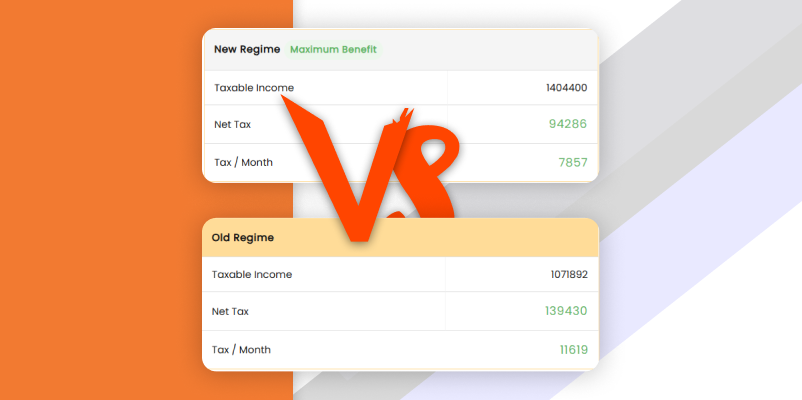
The discussion around the old vs new tax regime has become even more important in 2026, especially as the New Tax Regime is now the default option for all taxpayers. With revised slab rates coming into effect from 1 April 2026, salaried individuals are reassessing which regime helps them retain more income while keeping tax planning simple.
Your tax regime selection affects much more than your annual tax outgo — it shapes your monthly take-home salary, TDS calculations, investment behaviour, rent decisions, home-loan planning, and the level of documentation required.
Old vs New Tax Slab Rates (Applicable from 1 April 2026)
| New Regime Total Income | New Tax Rate | Old Regime Total Income | Old Tax Rate |
| Up to ₹4,00,000 | Nil | Up to ₹2,50,000 | Nil |
| ₹4,00,001 – ₹8,00,000 | 5% | ₹2,50,001 – ₹5,00,000 | 5% |
| ₹8,00,001 – ₹12,00,000 | 10% | ₹5,00,001 – ₹7,50,000 | 10% |
| ₹12,00,001 – ₹16,00,000 | 15% | ₹7,50,001 – ₹10,00,000 | 15% |
| ₹16,00,001 – ₹20,00,000 | 20% | ₹10,00,001 – ₹12,50,000 | 20% |
| ₹20,00,001 – ₹24,00,000 | 25% | ₹12,50,001 – ₹15,00,000 | 25% |
| Above ₹24,00,000 | 30% | Above ₹15,00,000 | 30% |
Comparison Table: Old vs New Tax Regime (2026)
| Feature | Old Regime | New Regime |
| Standard Deduction | ₹50,000 | ₹75,000 |
| Tax Rates | Higher | Lower |
| 80C/80D Benefits | Yes | No |
| HRA/LTA | Yes | No |
| Home Loan Interest | Yes | No |
| TDS | Higher | Lower |
| Form 16 | Detailed | Simple |
| Best For | High deductions | Low deductions |
| 87 A | 12500 | 60000 |
Who Should Choose the New Regime?
The New Regime is suitable for individuals who:
- Do not invest in many tax-saving schemes
- Live with parents or own their home
- Prefer higher monthly in-hand salary
- Do not want to submit proofs for deductions
- Switch jobs frequently and want simpler TDS handling
Old vs New Tax Regime: Major Differences
| Component | Old Regime | New Regime |
| Standard Deduction | ₹50,000 | ₹75,000 (from FY 2026) |
| HRA | ✔️ | ❌ |
| LTA | ✔️ | ❌ |
| 80C Investments | ✔️ | ❌ |
| 80D (Health Insurance) | ✔️ | ❌ |
| Home Loan Interest | ✔️ | ❌ |
| Professional Tax | ✔️ | ❌ |
| Complexity | Heavy documentation, detailed Form 16 | Clean payslips, fewer calculations |
Comparison Table (Old vs New Tax Regime – 2026) – Various Income Examples
| Regime | Net Taxable Income | Tax Implication |
| Old Regime | > 5lakhs | Taxable |
| New Regime | > 12 Lakhs | Taxable |
| (Net taxable income is the final income subject to tax calculation after applying all deductions) | ||
For 2026 Which Regime Works Better?
During job changes, document submission can be delayed, causing excess TDS.
The New Regime is easier because:
- No proofs needed
- Cleaner salary slips
- Better TDS predictability
You can still opt into the Old Regime while filing your ITR, even if your employer followed the New Regime all year.
What does the two-regime tax scheme tell us?
There is no single answer. The better regime depends on your income structure, rent situation, home-loan status, and investment habits.
- Choose the Old Regime if you maximise deductions and want deeper tax benefits.
- Choose the New Regime if you prefer simplicity, lower TDS, and higher take-home salary.
If all these calculations feel confusing, let Zlendo Suite simplify the process for you. It ensures a fast and accurate experience.
Disclaimer
The above information is collected from various online sources. It is not legal or financial advice. Readers should verify details through official government notifications or consult a qualified professional before making any decisions.